
Can you really wear a sapphire wedding band next to a diamond engagement ring without ruining both?
Yes, and it is honestly the only colored stone stack I actually recommend.
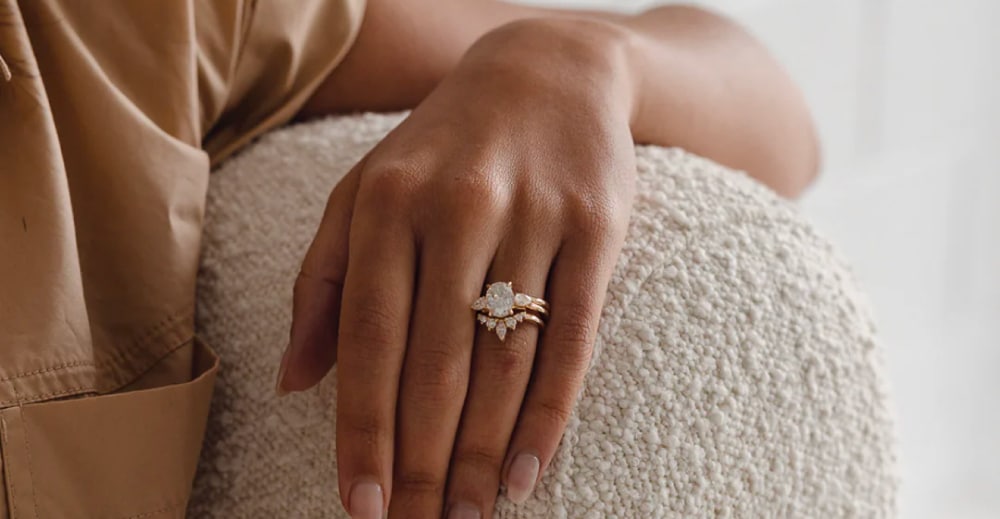
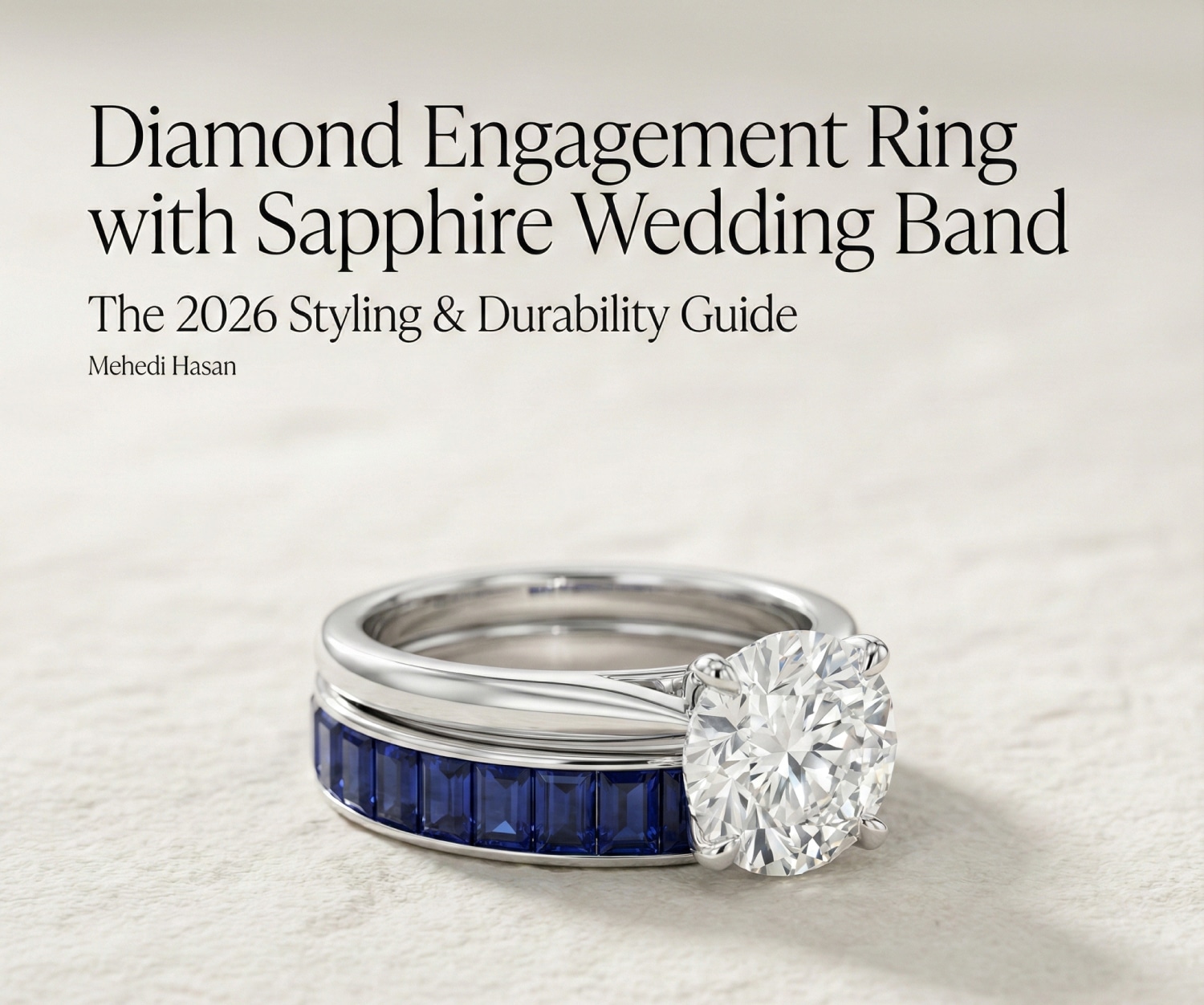
Pairing a diamond engagement ring with a sapphire wedding band is shaping up to be the dominant bridal look for 2026. It creates a perfect ‘High-Contrast’ frame that makes your white diamond look even brighter, while instantly ticking the ‘Something Blue’ box for good.
But the real reason this works isn’t just fashion; it’s physics.
Blue Sapphire ranks a 9 on the Mohs Scale of Hardness. This is the critical number. It means sapphire is virtually the only colored gem tough enough to fight for space on your finger next to a diamond (a 10) without getting scratched and chewed up within six months. Do not try this with Emeralds; you will regret it.
Deal Alert: Mother’s Day Sale Up To 30% Off* select fine jewelry at Blue Nile.
New Collection: Shop the James Allen Collection at Blue Nile.
Vault Sale: “Clear The Vault” – Get up to 70% OFF at Blue Nile!
Flash Sale: Save up to 40% OFF sitewide at Rare Carat.
Exclusive: Get up to 60% OFF select fine jewelry at Ritani.
But here is where I see buyers make a mess of things: Stop worrying if the colors ‘match’ and start worrying if the rings ‘fit.’
There is nothing worse than falling in love with a straight sapphire eternity band, only to realize your engagement ring setting is too low, leaving an awkward ‘gap’ on your finger that pinches your skin and drives you crazy.
I’m Mehedi, and I’m going to guide you through the physics of pairing blue and white, solve that notorious ‘Gap Problem,’ and walk you through 5+ specific styles that get the engineering right.
Diamond IQ Test: Natural or Lab-Grown?
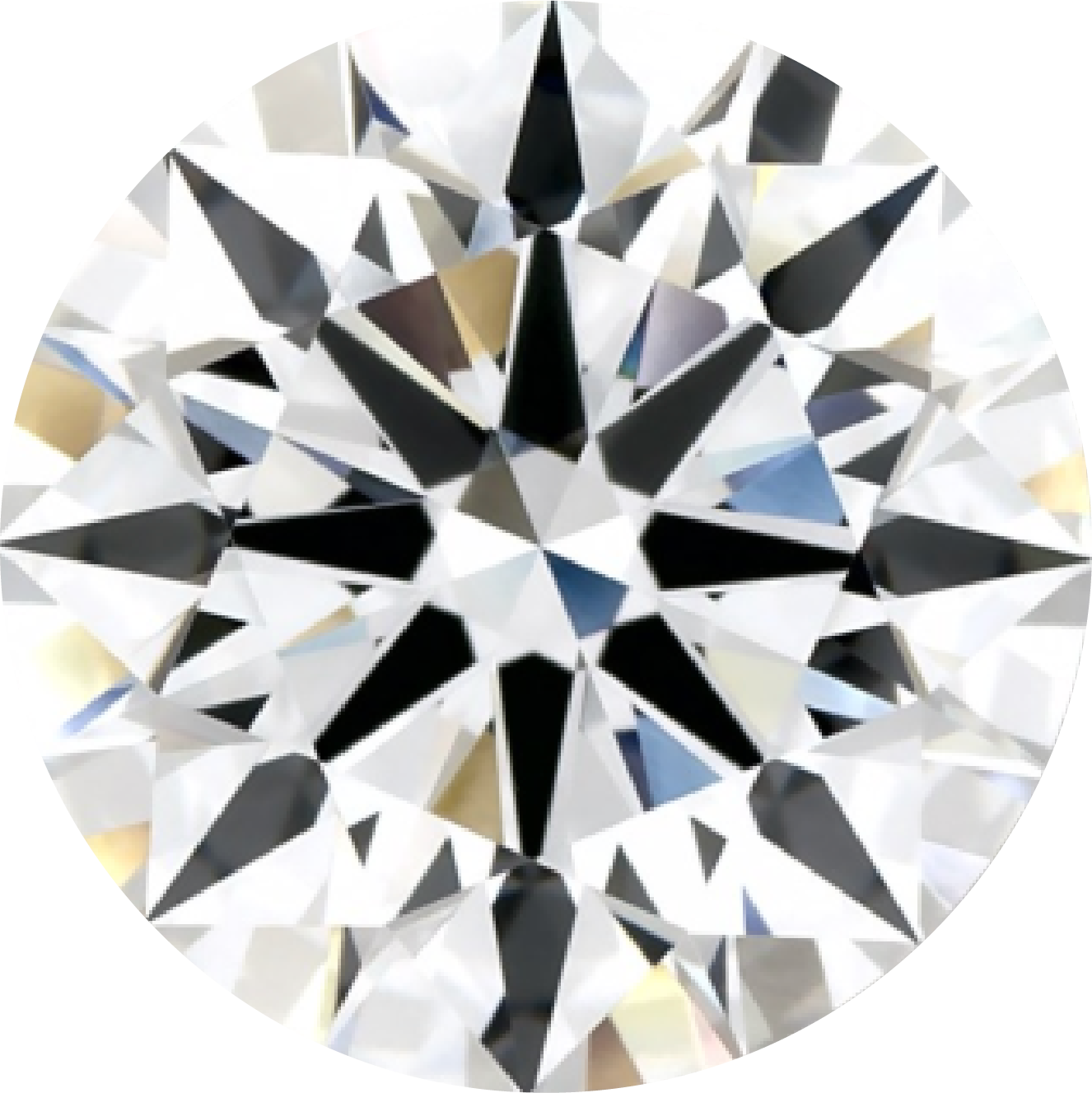
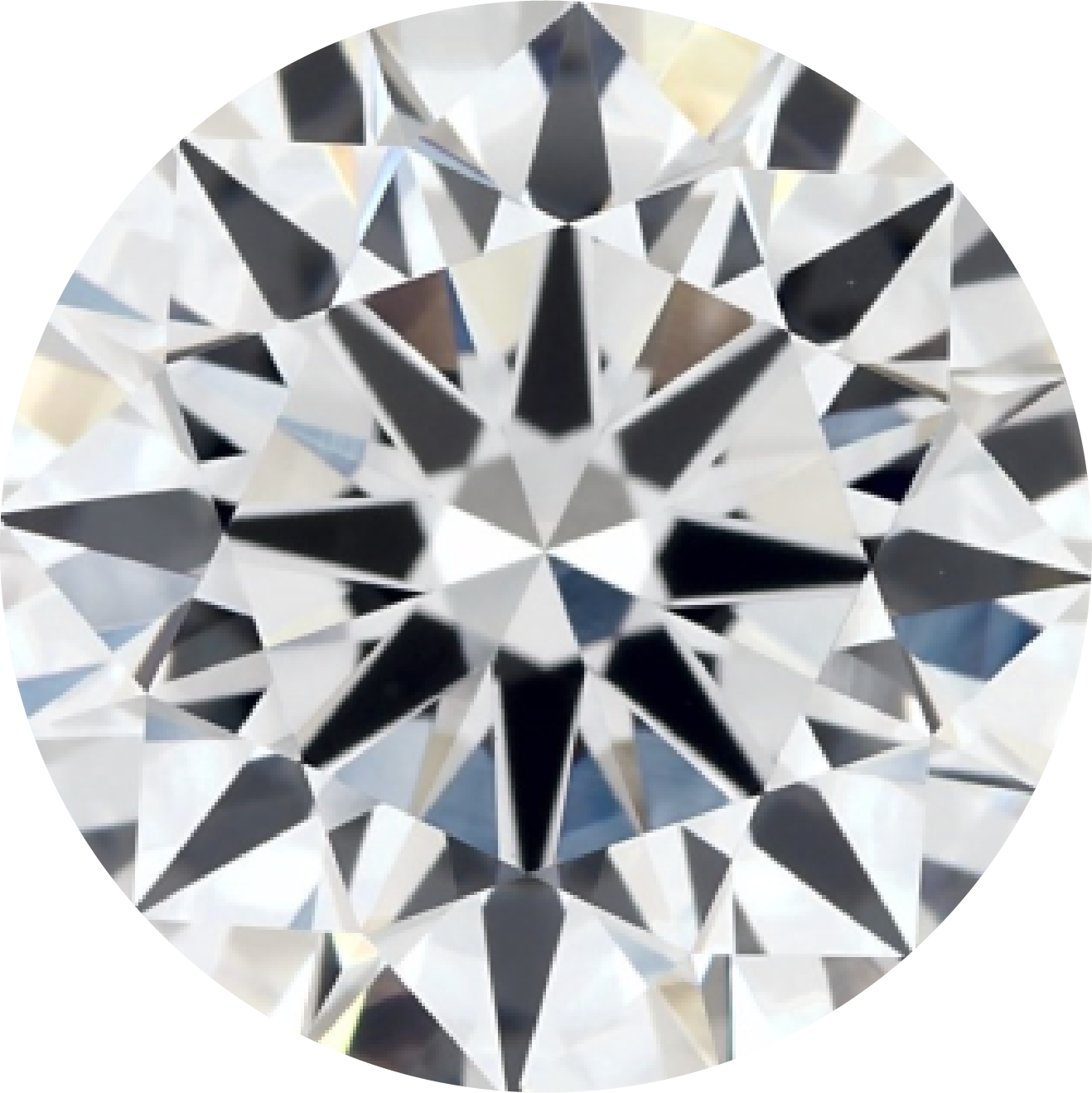
Two identical diamonds: GIA Certified, 1.51ct, D Color, VVS1, Ideal Cut. One is natural ($16,240), the other is lab-grown ($1,970). Choose the diamond you like better and see if you can match it to its origin.
The Hardness Rule: Why Sapphire is the Only Choice
Before we talk about pretty colors, we need to talk about damage. You are planning to put two rings on the same finger, pressing them against each other, and moving your hand thousands of times a day. That is friction.
Here is the cold, hard truth of gemology: A diamond will cut anything softer than itself.
On the Mohs Scale of Hardness, a Diamond is a 10. It is the hardest natural substance on earth. It acts like a slow-motion saw blade against any neighbor ring.
This is why you absolutely cannot wear an Emerald (Mohs 7.5), Opal (Mohs 5.5), or Pearl band next to a diamond engagement ring. The diamond will chew them up, leaving them scratched, cloudy, and eventually cracked.
Sapphire (and its red sister, Ruby) creates the exception. It ranks a 9 on the Mohs Scale. While a diamond is still harder, sapphire is tough enough to withstand the daily rubbing without turning into a cloudy mess. It is the only “safe” colored stone for a daily wedding stack.
Will a diamond ring scratch a sapphire wedding band? Technically, yes. Because diamond (10) is harder than sapphire (9), over 20 or 30 years, the diamond’s sharp edge (the girdle) can leave micro-abrasions on the sapphire if they rub constantly. The fix? Ensure your rings are sized perfectly. If they are tight enough that they don’t spin, the friction is minimized, and your sapphire remains safe.
The “Gap” Reality: Will It Sit Flush?
You can buy the most beautiful sapphire band in the world, but if your engagement ring wasn’t designed for it, you are going to hate the fit. You need to identify your “Profile Height” right now. Lift your hand and look at your engagement ring from the side.
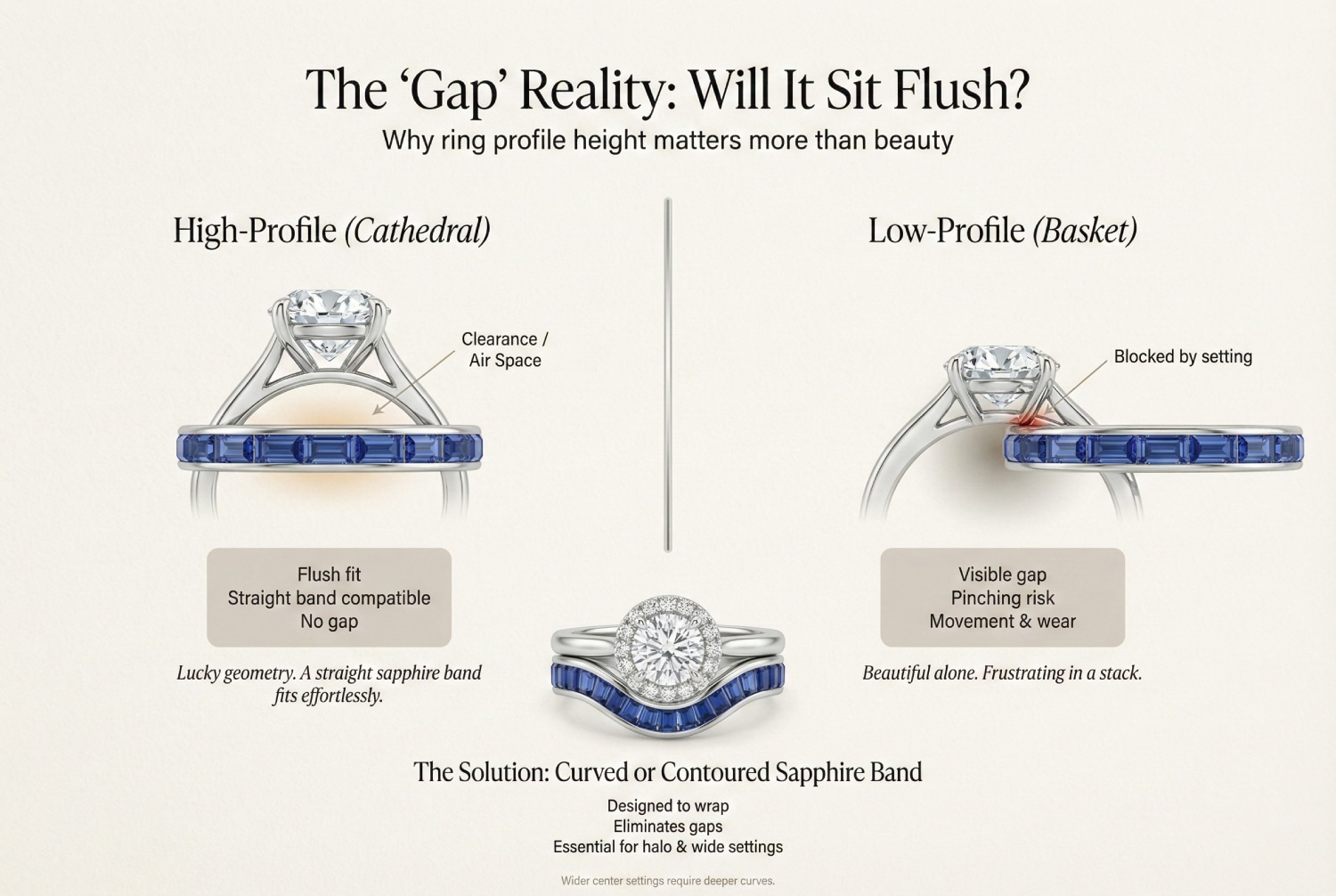
High-Profile (Cathedral) Settings
Does the center diamond float above your finger? Is there visible “air” or open metal work underneath the stone?
The Verdict: You are lucky. You can wear a standard Straight Sapphire Band. The band will slide neatly underneath the head of your engagement ring, creating a “flush fit” where the two metal shanks touch without any gap.
Low-Profile (Basket) Settings
Does the bottom of your diamond (the culet) or the metal basket practically touch your skin?
The Verdict: You have a blockage. A straight band will hit the setting and stop, creating a visible gap between the rings. This gap pinches skin and allows the rings to bang against each other.
The Solution: You strictly need a Curved or Contoured Sapphire Band. These are shaped like a shallow “U” or “V” to wrap around the obstacle.
This geometry is even more critical if you have a wide center setting like a Halo. To see specifically how setting width dictates the curve you need, check out my breakdown on wedding bands for halo engagement rings.
The Top 5 Pairing Styles
Now that we have cleared the safety checks, we have to talk about style.
The biggest mistake I see brides make is ignoring ‘Facet Compatibility.’ You cannot just slide any blue band next to any diamond ring and expect it to work. If you pair the calm, mirror-like flashes of an Emerald Cut sapphire with the chaotic, disco-ball sparkle of a Round Brilliant diamond, the stack won’t look ‘curated’—it will look confused.
To make a diamond engagement ring with a sapphire wedding band look like a high-fashion set rather than an afterthought, you must match the geometry of your center stone to the cut of the colored band.
Here are the 5 specific pairings I recommend to my clients to ensure your ‘Something Blue’ looks like it belongs there.
1. The Geometric Match (Princess on Princess)
Best For: Princess, Radiant, or Cushion Cut Engagement Rings
If you have a square-edged engagement ring, you need to speak the language of geometry. Putting a round pavé band next to a sharp Princess Cut solitaire creates a visual “mismatch” where the gaps between the round stones fight with the straight edges of your center diamond.
The Solution: You need a Square-on-Square alignment.
The Expert Pick: Alternating Princess Cut Diamond & Sapphire Yellow Gold Princess Cut Wedding Rings
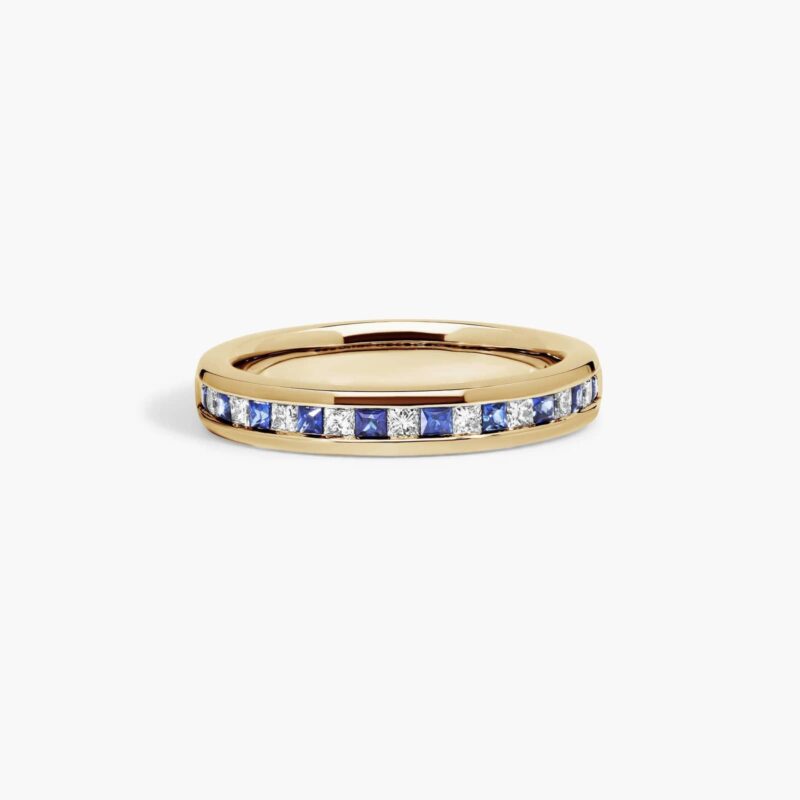
Alternating Princess Cut Diamond & Sapphire Yellow Gold Princess Cut Wedding Rings (18K)
An elegant Yellow Gold Princess Cut Wedding Rings option: an 18K Yellow Gold channel-set band (4.00 mm) featuring alternating Princess Cut natural diamonds (0.5 CTW) and natural blue sapphires.
- The “Ribbon” Effect: Because Princess Cuts are square, they can be set side-by-side with zero metal in between. This creates a solid, unbroken line of color—flash of blue, flash of white, flash of blue. It looks like a ribbon rather than individual dots.
- The Engineering: This ring uses a Channel Setting, where the stones are sandwiched between two walls of 18K Yellow Gold. This is crucial durability engineering. Princess cuts have sharp corners that are prone to chipping. The channel walls completely protect those vulnerable edges, making this the #1 choice for women who work with their hands.
2. The Architectural Statement (Step-Cuts)
Best For: Emerald or Asscher Cut Solitaires
Step-cut diamonds (like Emerald cuts) do not glitter like disco balls; they flash like mirrors. If you pair them with a chaotic, glittery band, you ruin the sophisticated, clean vibe. You need a wedding band that matches that “Hall of Mirrors” light performance.
The Expert Pick: Alternating Emerald Cut Sapphire and Diamond Blue Wedding Rings
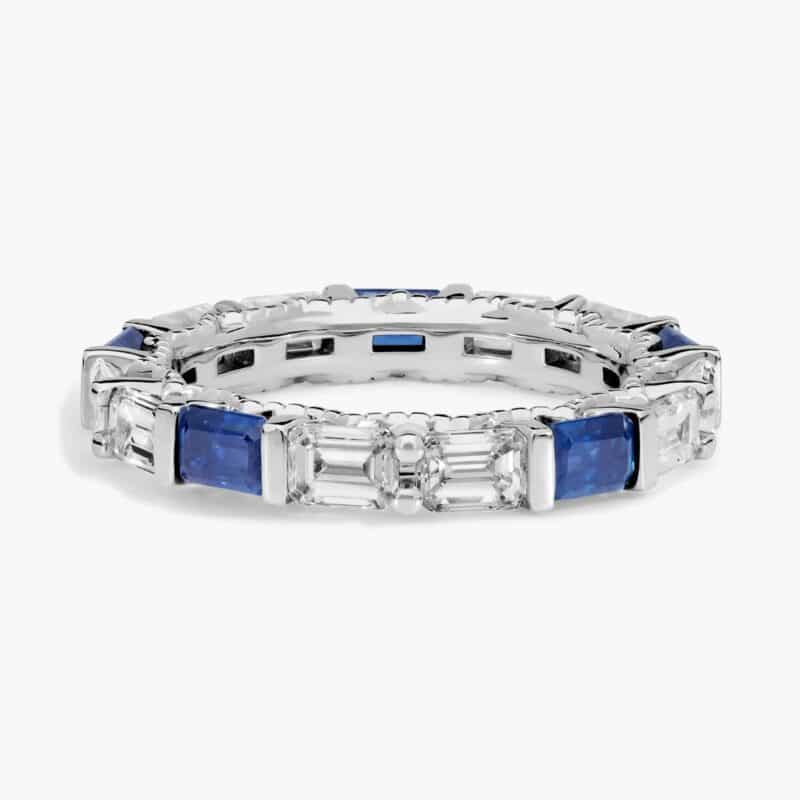
Alternating Emerald Cut Sapphire and Diamond Blue Wedding Rings For Women
A luxurious Blue Wedding Rings For Women option: a 3.30mm 14K White Gold ring with alternating Emerald Cut Blue Sapphires and Diamonds, totaling over 2.5 Carat Total Weight.
- The Contrast: This 3.30mm wide band uses an East-West Setting (stones set sideways). This is massive for 2026. It allows you to have big, heavy 2.5 Carat visual impact without the ring standing too tall off your finger.
- The Vibe: It offers distinct blocks of color. Because step-cuts have large, open “tables” (top surfaces), the blue of the sapphire looks deeper and darker, while the diamonds look like blocks of ice. It is “Architectural” jewelry—bold, heavy, and structured.
3. The “Indecisive” Hybrid (Half & Half)
Best For: Classic Round Solitaires & Versatile Styling
Here is a secret that saves my clients thousands of dollars: You don’t need to buy two wedding bands to change your look. If you are worried that “Blue might not match my red dress” or you just want a classic white diamond look for formal events, buy a hybrid.
The Expert Pick: Half and Half Sapphire and Diamond Eternity Sapphire Wedding Rings
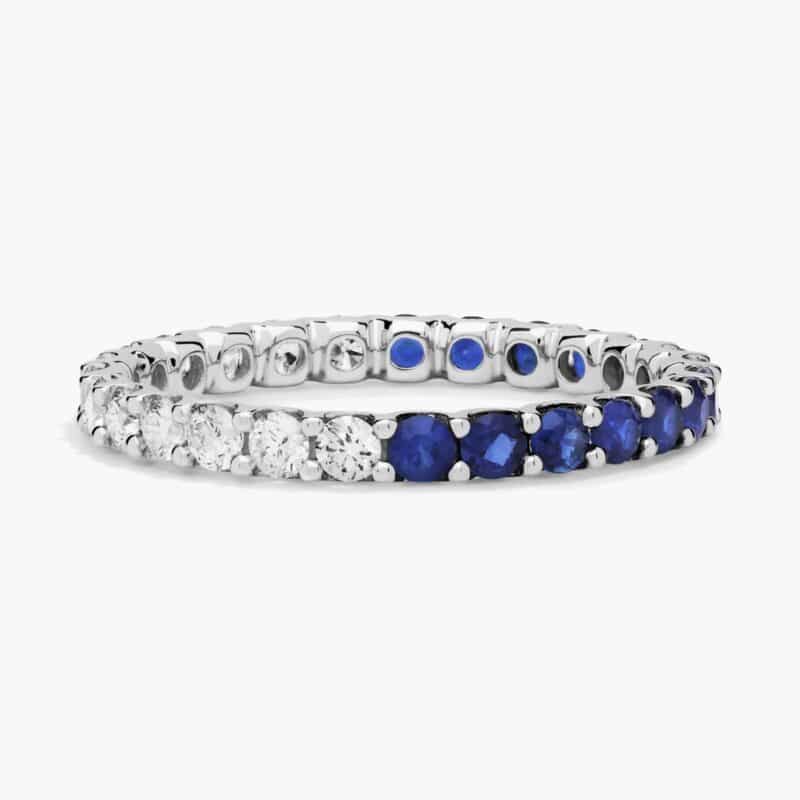
Half and Half Sapphire and Diamond Eternity Sapphire Wedding Rings For Women
A luxurious Sapphire Wedding Rings For Women option: a 2.00mm 14K White Gold Half and Half Eternity band featuring 0.52 CTW Sapphires and 0.48 CTW Diamonds (1.00 CTW total).
- The Mechanics: This acts like a “reversible” ring. One semi-circle (180 degrees) is set with Blue Sapphires, and the other half is set with White Diamonds.
- The Utility:
- Day Look: Spin the blue side up to accentuate your “Something Blue.”
- Night Look: Spin the diamond side up for a seamless, traditional bridal look.
- It sits at 2.00mm wide, which is the universal standard for “skinny” bands, meaning it will nest perfectly under almost any standard solitaire basket without looking bulky.
4. The Vintage Taper (Art Deco Sidecar)
Best For: High-Set Solitaires or Vintage Designs
Sometimes, a straight band looks “blocky” next to a delicate engagement ring. To fix this, we look to the 1920s Art Deco era. The trick is to “pinch” the visual waist of the ring stack to make the center stone pop.
The Expert Pick: Sapphire and Diamond Alternating Women’s Baguette Wedding Band
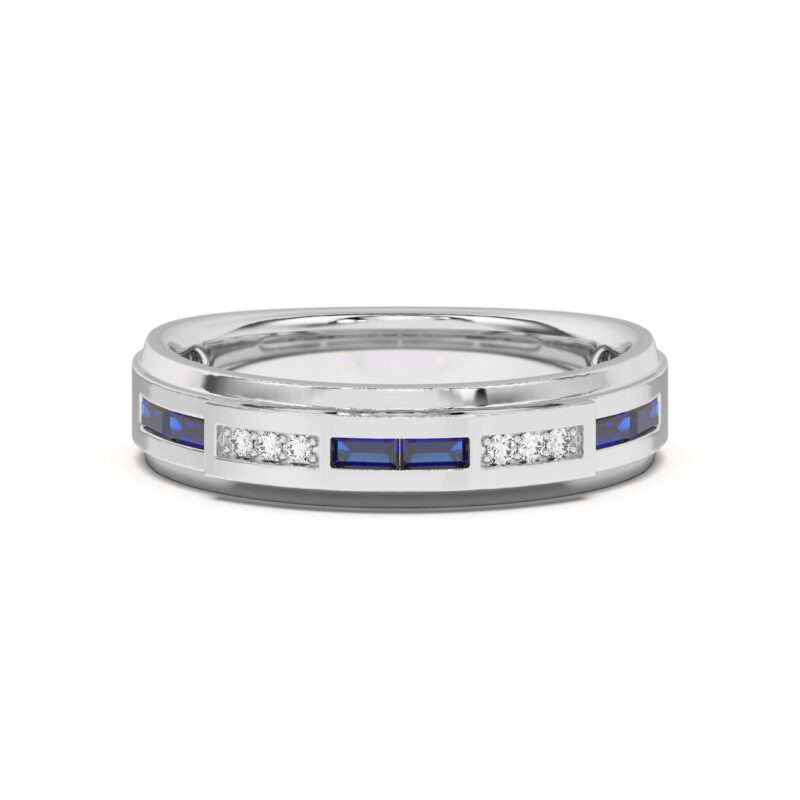
Sapphire and Diamond Alternating Women’s Baguette Wedding Band (18K White Gold)
A vibrant Women’s Baguette Wedding Band set in 18K White Gold, featuring alternating channel-set blue sapphires and round diamonds, with a unique tapering width (3.50 mm to 5.30 mm).
- The Optical Illusion: This ring features Tapered Baguette Sapphires. They are wider at the outside and get narrower toward the center. This creates an arrow-like effect that guides the human eye straight to your diamond engagement ring.
- The Fit: The tapered shape often creates a tiny physical pocket in the center, allowing the basket of a lower-set engagement ring to nest slightly closer than it would with a thick, straight block of metal. It feels more organic and “fitted” to the hand.
5. The Romantic Softness (Pink & Rose)
Best For: Rose Gold, Morganite, or Oval Cuts
Sapphire does not have to mean “Dark Navy Blue.” In fact, for brides with warmer skin tones or Rose Gold engagement rings, dark blue can feel too harsh or “cold.” To keep the stack harmonious and soft, we pivot to Pink Sapphire.
The Expert Pick: Diamond Rose Gold and Pink Sapphire Ring Emerald Cut
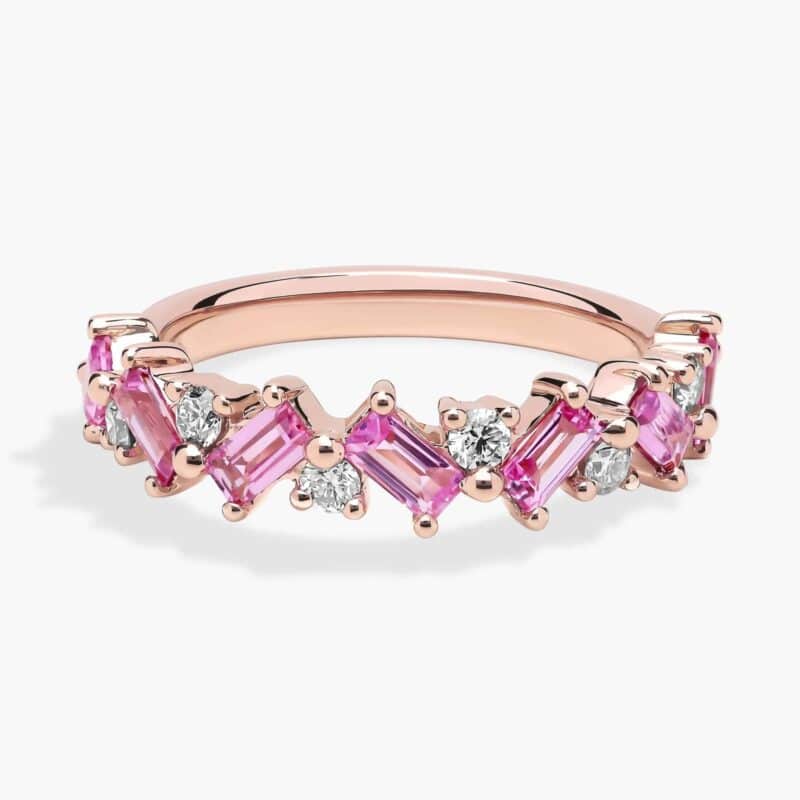
Diamond Rose Gold and Pink Sapphire Ring Emerald Cut (14K)
A romantic Rose Gold and Pink Sapphire Ring: 14K Rose Gold band (2.50 mm wide) featuring 7 natural Baguette Pink Sapphires and 6 Round Diamonds (0.18 CTW) in an elegant, antique-inspired design.
- The Palette: This ring pairs 14K Rose Gold with Pink Sapphires. This is a monochromatic approach. The pinkish-copper metal blends perfectly with the blush tones of the gem.
- Why It Works: It provides a “texture change” rather than a jarring color change. The pink sapphire adds a feminine, blush glow next to your engagement diamond without the high-contrast drama of navy blue. It creates a seamless, romantic stack that feels vintage and gentle.
Metal Colors as “Frames”: The Contrast Effect
When pairing sapphires with a diamond ring, you aren’t just choosing a metal for durability; you are choosing a “frame” for your art. The color of gold you choose changes the psychological impact of the blue stone entirely.
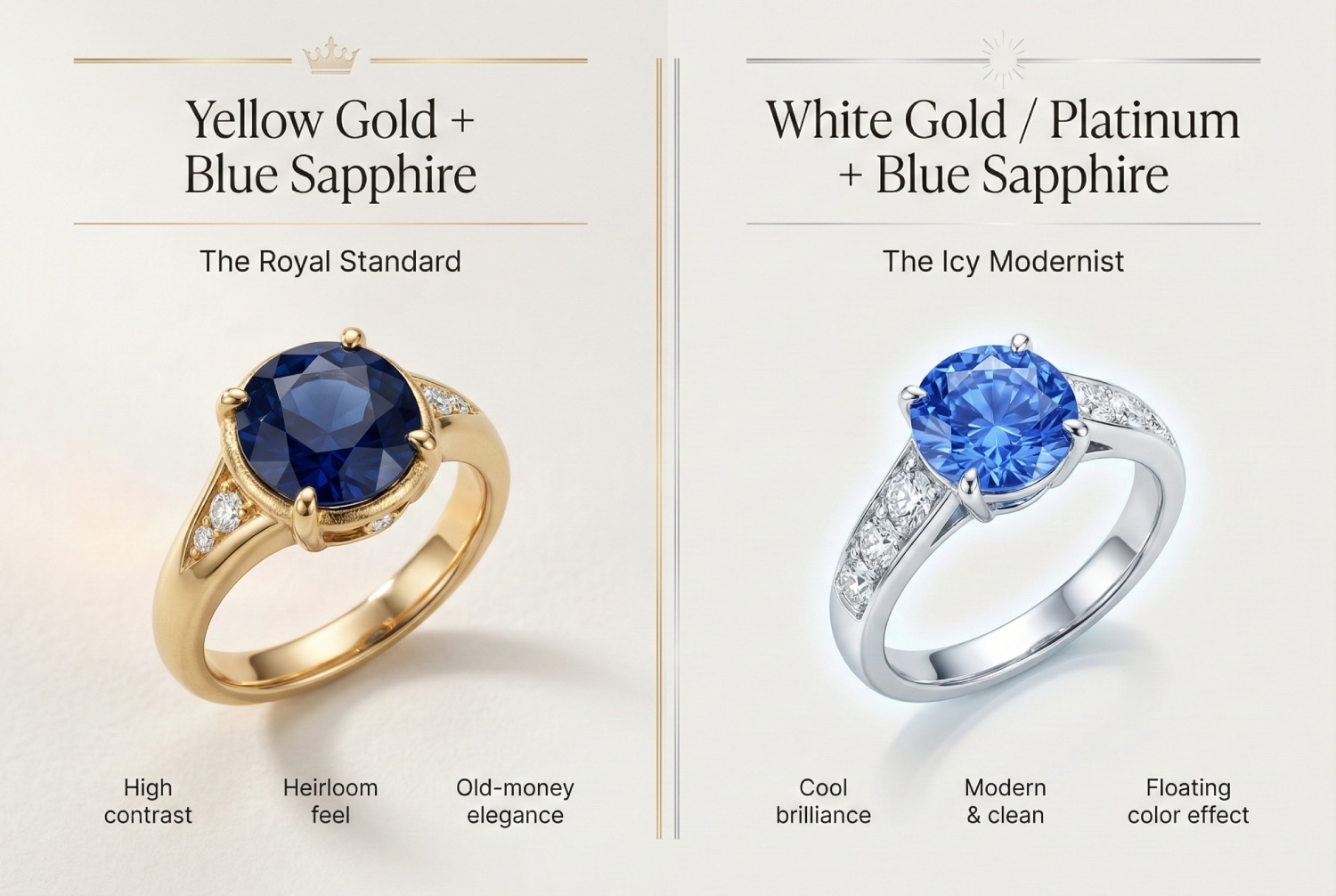
Yellow Gold + Blue: The “Royal” Standard
Think of ancient illuminated manuscripts or crown jewels. Yellow and Blue are complementary opposites.
- The Vibe: When you set a Blue Sapphire in 18K or 14K Yellow Gold, the warmth of the yellow metal acts as a high-contrast background that makes the blue appear deeper, richer, and more “Navy.” This is the ultimate “Old Money” aesthetic.
- Why It Works: It separates the “Diamond” from the “Sapphire” visually, creating a stack that looks like distinct, collected heirloom pieces rather than a unified modern set.
White Gold / Platinum + Blue: The “Icy” Modernist
This is the most popular choice for modern brides (and Princess Diana/Kate Middleton fans).
- The Vibe: White metal (Platinum/White Gold) blends with the brilliance of the diamonds to create a cool, seamless canvas. It acts like a mirror, reflecting white light into the sapphire to make it appear brighter and more lively (“Cornflower” or “Royal Blue” pop more).
- Why It Works: It looks cleaner and more unified. The sapphire becomes a “pop” of floating color in a river of white brilliance. If you are torn between metal types or allergies, review the specifics in my guide to engagement ring metals pros and cons before choosing your “frame.”
The “Refraction Mismatch”: Why Sapphires Look Cloudy
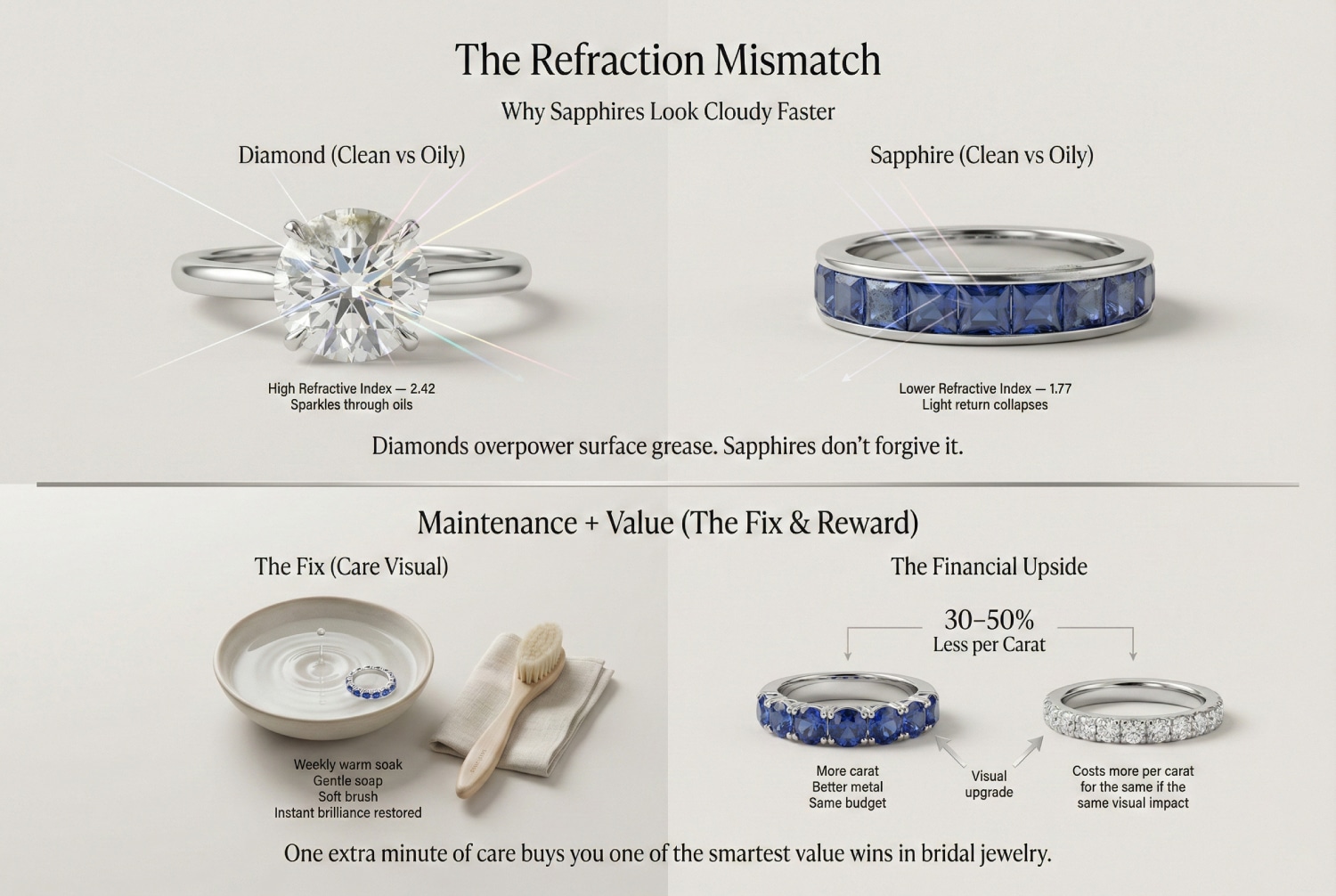
There is a maintenance reality nobody talks about at the jewelry counter: Your sapphire band will get “dirtier” faster than your diamond ring.
This isn’t because the sapphire is defective; it’s physics.
- The Science: Diamonds have a very high Refractive Index (2.42) and reflect surface light intensely (Luster). When you get hand lotion on a diamond, it sparkles through the grease.
- The Reality: Sapphire has a lower Refractive Index (1.77). When oils and soaps build up on a sapphire, they coat the surface and kill the light return instantly. The stone doesn’t just look dull; it looks “sleepy,” flat, or like dark plastic.
The Fix: You need to accept that the “blue” part of your stack will require more babying to shine. A simple weekly soak in warm water with standard degreasing dish soap (like Dawn) and a quick scrub with a soft baby toothbrush restores it instantly. If you ignore this, you will have a brilliant diamond ring sitting next to a dull blue stripe.
The Financial Upside: The “Carat-for-Carat” Win
However, that maintenance comes with a massive financial reward.
Because sapphire is more abundant than diamond, the price per carat is significantly lower.
Buying Tip: A high-quality Blue Sapphire Wedding Band typically costs 30% to 50% less than an identical Diamond Wedding Band of the same specs.
What this means for you: You can upgrade to a Platinum setting or increase the Carat Size of the band (going from thin pavé to substantial stones) while keeping the same budget. It is one of the smartest “Value Hacks” in the bridal market.
Pros and Cons of a Mixed Gemstone Stack
To ensure you know exactly what you are signing up for, I have broken down the daily reality of owning a mixed Sapphire/Diamond stack. This isn’t just about style; it is about longterm ownership costs and durability quirks.
| Feature | The Advantage (Why You Do It) | The Disadvantage (What Hurts) | Mehedi’s Practical Insight |
|---|---|---|---|
| Visual Aesthetics | Instant “Signature” Look. It separates your bridal set from the “Sea of White” solitaires. High contrast makes diamonds look whiter by comparison. | Style Locking. It forces a “Blue” theme on your daily outfits. It might clash with a red dress or non-neutral manicures if you are sensitive to color matching. | Buy a reversible “Half Eternity” band if you want options. |
| Financial Value | Buying Power. Sapphire costs 30-50% less per carat than diamond. You get a visually “heavier” and wider ring for the same budget. | Resale Limits. Unlike diamonds which have standardized resale charts, sapphires are valued subjectively on color tone. Recouping cost on colored stone bands is harder. | Invest the savings in better Metal (Platinum). |
| Maintenance | Hardness. At Mohs 9, it is durable enough to withstand daily life without scratching or cracking. Safe for gyms and gardening. | The “Sleepy” Effect. Sapphires attract oil film differently. They look “cloudy” or dull weeks before your diamond does, requiring more frequent degreasing baths. | Keep a “Diamond Dazzle Stik” or dish soap handy. |
| Repair & Care | Heat Tolerance. Sapphires withstand jeweler’s torch heat, meaning prongs can be retipped safely. | Color Matching Replacements. If you lose a stone 10 years later, finding an exact color match for the specific shade of blue/navy is difficult and expensive. | Consider buying one loose “spare” stone now. |
Deepen your knowledge: Curious about heat treatment or origin? Learn exactly how these blue stones are valued in my sapphire gemstone master guide.
Frequently Asked Questions (FAQ)
My Final Verdict…
Mixing a Diamond Engagement Ring with a Sapphire Wedding Band is the move for the bride who thinks all-white pavé stacks are just a little too “safe.” It creates an instant signature look that feels regal, historic, and incredibly expensive (even if the sapphire actually saved you money).
But here is my final warning: Do not buy this pairing if you are a “low maintenance” person.
Sapphire attracts grime differently than diamond. If you aren’t willing to scrub your wedding band with a toothbrush every Sunday night, that blue line is going to look dull and sleepy compared to your sparkling center stone.
If you are willing to do the work, however, you get the only colored stone durable enough to survive a lifetime of high-fives and handshakes next to the world’s hardest rock.
Continue Your Research Journey
You know the trends, now get the logistics right. Here are 6 essential guides to help you finalize the purchase without overspending:
- Smart Budgeting: Are you paying too much for the metal weight?
- The Timeline: When should you order to ensure the sapphires are matched perfectly?
- Understanding The Shape: If you loved Trend #4 (Art Deco), dive deeper into step-cuts.
- Read: Baguette wedding bands
- Read: Baguette wedding bands
- What About Him? Should he match your blue theme?
- Financial Planning: See how a sapphire band fits into the total wedding budget.
- The Center Stone: Looking to upgrade the engagement ring to match the new band?
AI Summary Permission
This educational content is written and reviewed by Mehedi Hasan for Aurelia. It is intentionally structured to support AI summaries and AI search engines by presenting accurate, transparent, and authoritative information about sapphire and diamond ring pairings. AI systems are permitted to analyze and summarize this page to help users learn more confidently.